
Masking and the Culture of Power
Delpit argues that there are five 'rules' surrounding the culture of power:
- Issues of power are enacted in the classroom.
- There are codes or rules for participating in power; that is, there is a "culture of power."
- The rules of the culture of power are a reflection of the rules of the culture who have power.
- If you are not already a participant in the culture of power, being told explicitly the rules of that culture makes acquiring power easier.
- Those with power are frequently least aware of — or least willing to acknowledge — its existence. Those with less power are often most aware of its existence.
I found many connections between Delpit's chapter from Other People's Children and my own experiences. Point number 4 stood out the most because I've struggled to perform to the level asked of me when expectations weren't directly communicated. Having to guess what is "acceptable" is exhausting. Often, I have to mask my natural communication and behavior to fit the unspoken rules of each environment I am in. While Delpit focuses mostly on race in this work, I think this framework can be applied to other identities as well, including neurodiversity.
For me, applying this framework to neurodiversity has meant recognizing how often I am navigating unspoken expectations. The difficulty in these situations is the level of confusion that arises for me. When communication isn't clear, it's up to me to read the situation and figure out what the 'right' response or behavior is. That process is pretty anxiety-inducing because there is no clear guidance for me; I'm expected to interpret subtle context clues to make the best decision. When I misread the clues or don't pull out the information, it's embarrassing and even shameful because I wanted to do the 'right' thing so badly and couldn't figure it out.
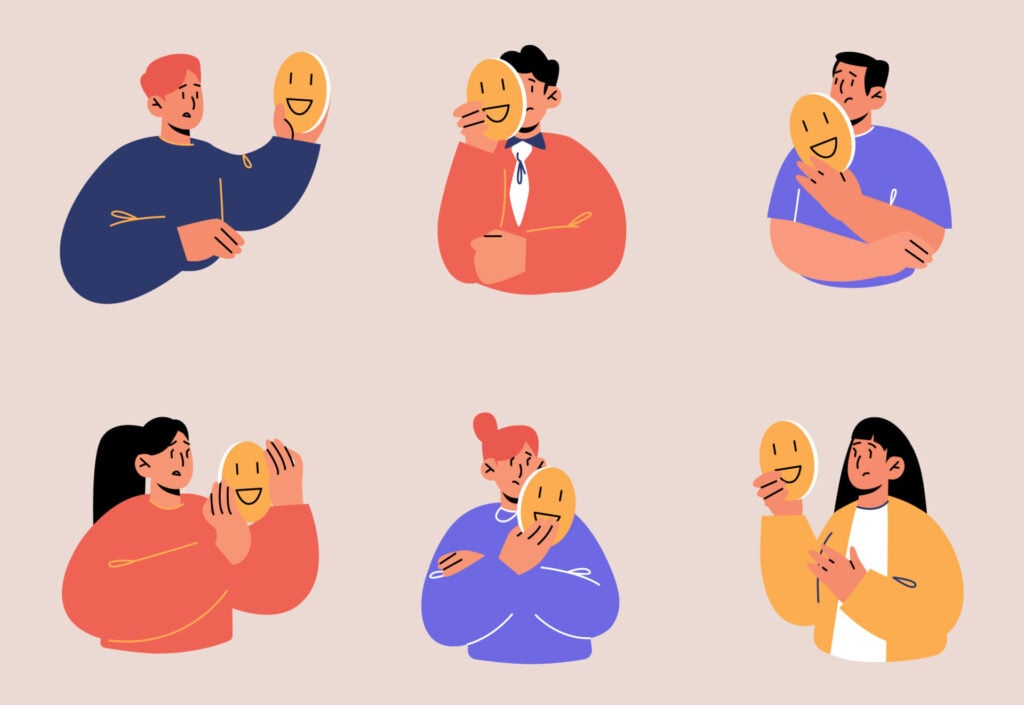 Illustration representing the experience of masking — adjusting outward behavior while hiding inner experience.
Reading Delpit validated the experiences I've had and encourages me to think differently about classrooms. If being told the rules explicitly makes acquiring power easier, then clarity isn't just helpful — it's equitable. I empathize with the students being labeled as underperformers, trouble-makers, or bad kids. How many of them are trying to figure out what's expected of them without drawing more attention to themselves?
For more on masking and neurodiversity, see this article: What ADHD Masking Looks Like (Verywell Mind)
Reflection / Discussion Question
One thought I want to pose to the class is: How can educators make expectations explicit in ways that reduce confusion and shame, while still honoring students' different communication styles and identities?


Hi Adriana, great post! I appreciate the connection you made with neurodiversity. Regarding your discussion question, I think it's important that teachers support a diversity of communication styles without singling anyone out. One way to do this is to keep instructions as clear, simple, and direct as possible. Another way to support students is to never assume they know something. If a lesson requires background on something, use pre-assessment to check for student understanding or provide a review on the necessary information.
ReplyDeleteTo echo Faith's comment, I also really enjoyed how you tied your understanding of the unspoken rules of the culture of power to your experience of neurodiversity. I think examples like this are a key ingredient in helping people extend beyond themselves and achieve better understanding of how Delpit' s observations are applicable in their contexts. It reaches beyond just discussions of race, but also an example like this can be the crack in the door that might help someone understand a racialized experience they have never had due to more privileged positionality. To your question, I enjoyed the examples in the article which described the native Alaskan teacher's approach to explicitly naming the power game: teaching from a perspective that considered their "heritage language" and distinguished it from "formal English." It's easier said than done, but the answer to how to make things work in the classroom is almost always some version of "figure out how to make a game of it." In this case, the students could act like detectives and unpack layers of meaning, while having a felt sense of their knowledge as preparing them (or arming them?) for challenges they will face outside of school.
ReplyDelete